Tag Archive: monarch migration

California Western Monarch Day ~ February 5th

Monarchs overwintering at Pismo Beach Butterfly Grove, California

Western Monarchs Overwintering at Pismo Beach, California

February 5 is California Western Monarch Day, established by the state Legislature in 2004.  California Western Monarch Day celebrates the annual migratory return of the Western Monarch Butterfly to the central coast of California to spend the winter during October through March.

Thousands of Western Monarch Butterflies overwinter on the California coast each year.  One of the most popular spots for the Western Monarchs is Pismo Beach, California.  As of January, 23 , 2012 the count is more than 23,000 monarchs at the Pismo Beach Grove. The migration draws many visitors along the central coast.  The migration of the monarch butterfly is studied and celebrated by school children in California, across the United States, and in Mexico.

EVENTS

Mile Square Regional Park ~ Saturday, February 4th, 2012

This is the 2rd annual Monarch Butterfly Day at Mile Square Park. Children and families are welcome to come learn about the California Western Monarch Butterfly and its habitat with an up-close look at the magnificent creatures while they flutter through the Butterfly Garden and inside a netted butterfly enclosure in the park’s Camp Sycamore. Children can help the Butterfly Garden continue to grow by planting native plants in the garden to attract Monarch Butterflies. More than 140 plants will be available for planting on February 4th. Butterfly experts will also be on-site to provide educational information and answer questions about the beautiful and unique specimens.  Additional event activities include children’s crafts, face painting, guided nature walks through Mile Square Regional Park’s nature area. Each child in attendance will receive native seeds as a take away to continue to help build safe habitats for Monarch Butterflies and other creatures.

Event Time: 10:00 to 2:00
Event Fee: Event is free
Parking Fee: $5 per vehicle
Age: Recommended for ages 4 to 12
Special Instructions: Please be advised rain will cancel the event.

Mile Square Park
16801 Euclid
Fountain Valley, California 92708
(714)973-6600 or (714)973-3197

Pismo Beach Monarch Butterfly Grove ~ Saturday, February 4th, 2012

Plans are in place for a joyful celebration of Western Monarch Day at the Pismo Beach Monarch Butterfly Grove. There will be butterfly talks and educational booths for adults, as well as art activities for children. The main attraction, however, is the thousands of Monarchs hanging in huge clusters from the eucalyptus and pine trees in the grove. The grove will remain open through the month of February from 10:00 am – 4:00 pm with docents providing daily talks at 12:00 pm – 2:00 pm. For more information, please visit www.MonarchButterfly.org

Times: 10:00 am to 4:00 pm
Parking: Free
Admission Fee: Free

Monarch Butterfly Grove
Monarch Butterfly Grove, Hwy. 1
Pismo Beach, California
(805) 773.7034

Citizen Science Butterfly Count in Limestone Canyon ~ February 5th, 2012

Join staff and local butterfly experts on IRC’s annual butterfly count! We will be recording number and types of butterflies encountered along the trails of Limestone Canyon. Our butterfly count will provide a benchmark estimate of diversity and number of these beautiful insects to compare to future local surveys and to larger patterns being compiled nationwide. Be prepared to learn about some new species if you’re new to this activity, or to share your appreciation and knowledge of butterflies.

Time: 8:30 AM
Activity Type: Citizen Science
Distance: 2+ miles
Duration: 5 hour(s)
Guided: Docent-Led
Reservations needed
Event is limited to space, please visit the IRC’s Website to sign up for a reservation.

They are a breath of beauty fluttering by They are mystery chronicled upon wing They bring forth the grace and wonder of this world to our eyes everyday ~K. D’Angelo

Madame Monarch’s Journey Home…

Madame’s Journey Home is a sweet tale of a Monarch Butterfly’s journey. The vivid and delightful pictures, illustrated by the authors son, will reach out and touch your heart! This is wonderful book, an inspirational story of Love shared with the world…

From the Author, Mariosa: Madame’s Journey Home is a children’s book filled with a powerful message of love and transformation. It is a true story of a woman and her son that found a Monarch butterfly on the eve of a killing frost. They named her Madame. She lived with them for three months and became part of their community.

This is the story of an amazing journey and a very special circle of life.

Madame’s Journey Home is available through Amazon Books.

Ten Facts About Monarch Butterflies Everyone Should Know

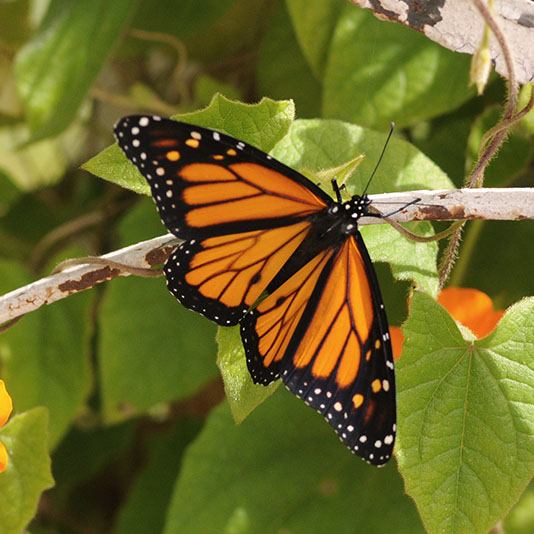
Female Monarch Butterfly on Pentas

MONARCH BUTTERFLY: TOP TEN FACTS

#1 MIGRATION

Hundreds of millions of monarch butterflies migrate from eastern North America to Mexico each fall to overwinter in the high elevation oyamel fir forests of the Transvolcanic Range of central Mexico. Monarchs are unable to survive freezing temperatures and those breeding in temperate regions must escape to moderate climates to reproduce the next season.

#2 GENERATIONS

Most of the monarchs joining the migration each fall are 3-4 generations removed from those that made the journey the previous year.

#3 TIME AND DISTANCE

The migration begins in mid August in the north and in September at mid latitudes. The migration progresses at a pace of 25-30 miles per day, although individual butterflies often fly further during periods when conditions are favorable. Most monarchs originate from locations more than 1500 linear miles from the overwintering sites. The duration of the migration appears to be 2-2.5 months.

#4 RECOLONIZATION OF THE SUMMER BREEDING AREAS

The monarch breeding areas in eastern North America are recolonized by two generations of monarchs; the overwintering butterflies that move north in the spring and their offspring. The latter reach maturity and begin flying N/NE in late April, reaching the northern limits of milkweeds by mid-June.

#5 LONGEVITY

Migratory monarchs that survive the winter in Mexico are 8-9 months of age and may be the longest lived of all butterflies. In contrast, reproductive monarchs breeding during the summer months only live 2-5 weeks due to the high cost of reproduction.

#6 NUMBERS

Monarch populations are measured as the number of hectares (1 hectare = 2.47 acres) of trees occupied by clustering butterflies in mid-December of each year. The size of the population has varied from 2.19 to 18.2 hectares over the last two decades; averaging close to 9 hectares in the 90s and between 5-6 hectares in this decade.

#7 NAVIGATION

Migrating monarchs in the interior of the continent fly in directions that seem to be geographically appropriate given the need to reach Mexico. How the butterfly determines these directions is the unanswered navigation question. Components of the navigational system that are known involve a time-compensated sun compass linked to the circadian clock, and a protein (Cry1) that is sensitive to blue light and ultraviolet wavelengths.

#8 TAGGING

Tagging by Monarch Watch volunteers has helped define the migration window as well as the timing and pace of the migration. Tagging also shows that the probability of reaching Mexico is related to geographic location, size of the butterfly, and the date (particularly as this relates to the migration window for a given location).

#9 DIMINISHING RESOURCES: THREATS TO THE MONARCH MIGRATION

During the breeding season monarchs require milkweed plants upon which to rear their larvae and nectar sources to sustain the adults during reproduction. Nectar sources are also required by the butterflies to fuel the fall migration to Mexico as well as the spring flights northward. Overwintering monarchs require shelter and water. All of these resources are diminishing. Deforestation at the overwintering sites in Mexico has eliminated a number of former colony sites and others have been badly degraded so as to reduce the shelter and water available to wintering butterflies. In the United States, 6000 acres are converted to development each day, eliminating milkweeds needed by monarch larvae and nectar sources required by adult monarchs. Chemically intensive agriculture and roadside management by excessive mowing and use of herbicides have also eliminated monarchs and their milkweed hosts. Lower numbers of overwintering monarchs in this decade may be related, at least in part, to habitat loss.

#10 CONSERVATION

Sustaining the monarch migration will require the cooperation of all three countries (U.S.A., Canada, Mexico) that are home to monarchs for some portion of the year. Future efforts will be based on the “North American Monarch Conservation Plan” – a program that advocates the implementation of measures to enhance, restore, and protect monarch habitats.

Thanks to Dr. Orley R. “Chip” Taylor, Director of Monarch Watch www.monarchwatch.org