Tag Archive: Butterflies

Enter The Lepidoptera Zone….

You unlock this door with the key of imagination…

(be sure to click on all images for a full view)

Beyond it is another dimension… a dimension of color, a dimension of flight, a dimension of wings.

You’re moving into a land of both butterflies and moths, of scales and eyespots.

You’ve just crossed over into The Lepidoptera Zone…


>>>


Mourning Cloak’s… A Joy to Behold!

The Mourning Cloak, Nymphalis antiopa, is one of the most common butterflies to be found in many regions throughout the world. There are several reasons why this handsome flier is so prevalent, but one of the most influential factors is that it uses a vareity of well known host plants, such as the Poplar, Cottonwood, Willow and Elm. These ardent trees are often wide spread and ample in supply, so it is no surprise that the butterfly, which depends on them, is also happily represented.

Mourning Cloak’s, like other Tortoiseshells and Anglewings, overwinter as adult’s and do not migrate. This, along with their ability to efficiently absorb heat into their dark scales, contributes to their having a longer season in which to frequent our skies. These hearty fliers are often among the very first butterflies to be seen in the spring and one of the last to disappear from sight in the fall.

Besides being conspicuous in their adult stage, Mourning Cloaks, are also known for their gregarious social behaviors as caterpillars. It is clear that they support the “There is Safety in Numbers” philosophy. Mourning Cloaks eggs are most always laid by the female in large groups and remain in this close knit formation throughout their larval stage. Birds and other predators are sure to be frightened off by a rowdy crowd of up to 50 or more spiky red and black caterpillars who may menacingly shake the branch in unison when threatened.

Only after having filled their voracious appetites, moving together, stripping one branch after another of its foliage, do the larva part ways. Trees appear to be raining caterpillars when the Mourning Cloaks begin to drop from them like parachuters. It seems as if these stealthy crawlers are fleeing the scene of a crime when they free fall unto the ground quickly seeking to distance themselves from their host plant. After taking the plunge, the caterpillars will journey alone until they find a safe place to pupate, metamorphose from chrysalis to butterfly, and be earth bound travelers no more.

Nymphalis antiopa is a delightful species which spreads it’s wings throughout  many countries, populating parts of Europe, Asia and the North American Continent. In England, this butterfly is known as the Camberwell Beauty, but worldwide is called by many other names such as Grand Surprise and White Petticoat.

In North America, due to its resemblance to a traditional cloak worn when one is “in mourning”, it has been given the title Mourning Cloak, but no matter where or by whom this reddish-brown, cream and blue beauty is spied, I think all can agree that she is a not at all sorrowful, but instead a true joy to behold.

Bugs ‘N Butterflies Event at Riley Wildernes Park

Join Obsession With Butterflies under the oak trees as entomologists and other enthusiasts share their knowledge of bugs and butterflies at the annual “BUGS ‘N BUTTERFLIES” event at Riley Wilderness Park on Sunday, June 6th 2010.

Meet Brent Karner from the LA Museum of Natural History, along with his  “Insect Zoo”. Brent will be demonstrating interesting insect and lifestyles.

Vendors include:

Gardening specialists will discuss planting California native drought tolerant plants to attract pollinators like butterflies, bees and hummingbirds.

Enjoy guided Ranger-led as well as self-guided Nature Walks, the Riley Park Butterfly Garden, a “Hawk Talk”, Nature Center, Kid’s activities and Crafts which will be offered throughout the day.

Its a fun day for the whole family!

Event Fee: Free with parking
Parking Fee: $3.00

Thomas F. Riley Wilderness Park Map Quest
30952 Oso Parkway
Coto de Caza, CA 92679
949-923-2265 or (949)923-2266

Mary Lou Heard Memorial Garden Tour 2010

Tour 39 of Orange County’s  most incredible gardens in full bloom, May 1st and May 2nd from 10:00am to 5:p00 pm

orange county garden tour

Mary Lou Heard Memorial Garden Tour

Each of these gardeners has generously consented to share their passion for gardening with us and I urge you to attend as many of the gardens on the tour as you can.

bleeding heart

Bleeding Heart

A bit of history about the Mary Lou Heard: In 1985, Mary Lou Heard opened Heard’s Country Garden Nursery, a magical nursery tucked away on a seldom traveled road in Westminster, California. The gardens were full of unique and often old fashioned annuals and perennials such as “Kiss Me Over the Garden Gate”, “Bleeding Heart” and “Four O’Clocks”. These, along with whimsical garden art, English and old garden roses, scented geraniums, herbs, vines and small trees made the nursery a delightful and special place to visit. In the center of the pebble-dusted paths was a small quaint old wooden “cottage” filled with gifts, books, potpourris and small bags of the finest organic fertilizers available. In the far back of the garden was another old wooden building, it too, filled with antiques, gifts and more home décor….it was for me, a gardeners’ shabby chic shopping heaven.

In 1993 Mary Lou came up with the notion of a garden tour, “real gardens by real people”. This is a self-guided tour, where you drive from home to home at your leisure to view the gardens.  The Heard’s Garden Tour was an instant success, bringing in over 800 garden lovers the first year and in later years, drawing in thousands of visitors. In 2000 Mary Lou Heard was diagnosed with cancer and two years later she would close her beloved nursery, and in her final Heard’s Country Garden Newsletter she wrote. “Though there are still many more gardens in my heat that have to be planted – the body is calling for a rest. Saying good-bye is the hardest thing I have had to do.”

The annual garden tour continues today, thanks to the Mary Lou Heard Foundation.

Anise Swallowtail Caterpillar

Anise Swallowtail Caterpillar Munching on Fennel

For those of us who had the pleasure of knowing Mary Lou Heard, this memorial garden tour holds a special place in our hearts. And for me, it’s especially significant, because it was at Heards Country Gardens Nursery, where I found my passion, butterfly gardening! Immediately upon attending a butterfly gardening class at the nursery, I was forever obsessed with butterflies. I was so fascinated with every detail of the butterfly class, taking notes and asking questions, that I could hardly wait to get home and start “gardening for the benefit of butterflies” myself. I especially remembered waiting in line to purchase a chrysalis from the teacher, Cathy, the “Butterfly Lady”, but to my disappointment, by the time I made my way to the front of the line, Cathy was out of butterfly chrysalises. She did however have a couple of caterpillars, and upon assuring her I was growing pesticide free fennel in my garden, she sold me one of her Anise Swallowtail caterpillars. I ever so carefully took it home, fed it, fretted over it, until finally that memorable day came when my Anise Swallowtail Butterfly emerged from it’s chrysalis, I knew I was hooked.

butterfly garden

Wood’s Wildlife Wonder

This story brings me to tell you about one of the gardens on the Mary Lou Heard Memorial Garden Tour, it’s at the home of Helen and Ken Wood. The “Wood’s Wildlife Wonder” is filled with plants and trees selected to attract butterflies and hummingbirds. Helen is a master gardener, her garden is certified as a  North American Butterfly Association certified butterfly garden, Monarch Way-station and Native Habitat. Last summer I had the pleasure of attending a “butterfly tea” at her home and was amazed at the number of butterflies visiting her garden. If you live in the Orange County area, I urge you to take the Heard’s Garden Tour, and don’t miss stopping by the Woods Garden, I’m sure Helen would be happy to talk to your about butterfly gardening. Be sure to bring your camera!

Mary Lou introduced me to the world of butterfly gardening,  I hope to inspire others to take the tour and begin gardening for the benefit of butterflies. ~Vickie

For a list of gardens on the 2010 tour, visit heardsgardentour.com

Sharing Butterfly Blogs…

Spring is in the air and we are starting to spy butterflies dancing on petals, sipping fine nectar and basking in the warm sunshine.  We would love to see some of the butterflies that have landed on your blogs.  Drop us a comment and be sure include a link to your favorite butterfly inspired blog.

Malachite Butterfly on Lantana

To include your butterfly related web site’s link on our OWB Links and Resource Page, we kindly ask you provide a reciprocal link to either our website or blog.

OWB Website:  http://www.obsessionwithbutterflies.com
or
OWB Flutter-Blog
:  http://www.obsessionwithbutterflies.com/blog/
or
OWB Butterfly Gift Shop:
http://www.obsessionwithbutterflies.com/shop/

Once you’ve linked to our website or blog, submit your link to our links page. We’ll usually get your link up within 24 hours!

I Saw A Little Butterfly…

I SAW A LITTLE BUTTERFLY

I saw a little butterfly flying atop.

I said, “Please, Mr. Butterfly, won’t you stop”.

He flapped his bright wings and had no word to say.

And before I could get near him, he fluttered away!


The Flying Irish… Butterflies?


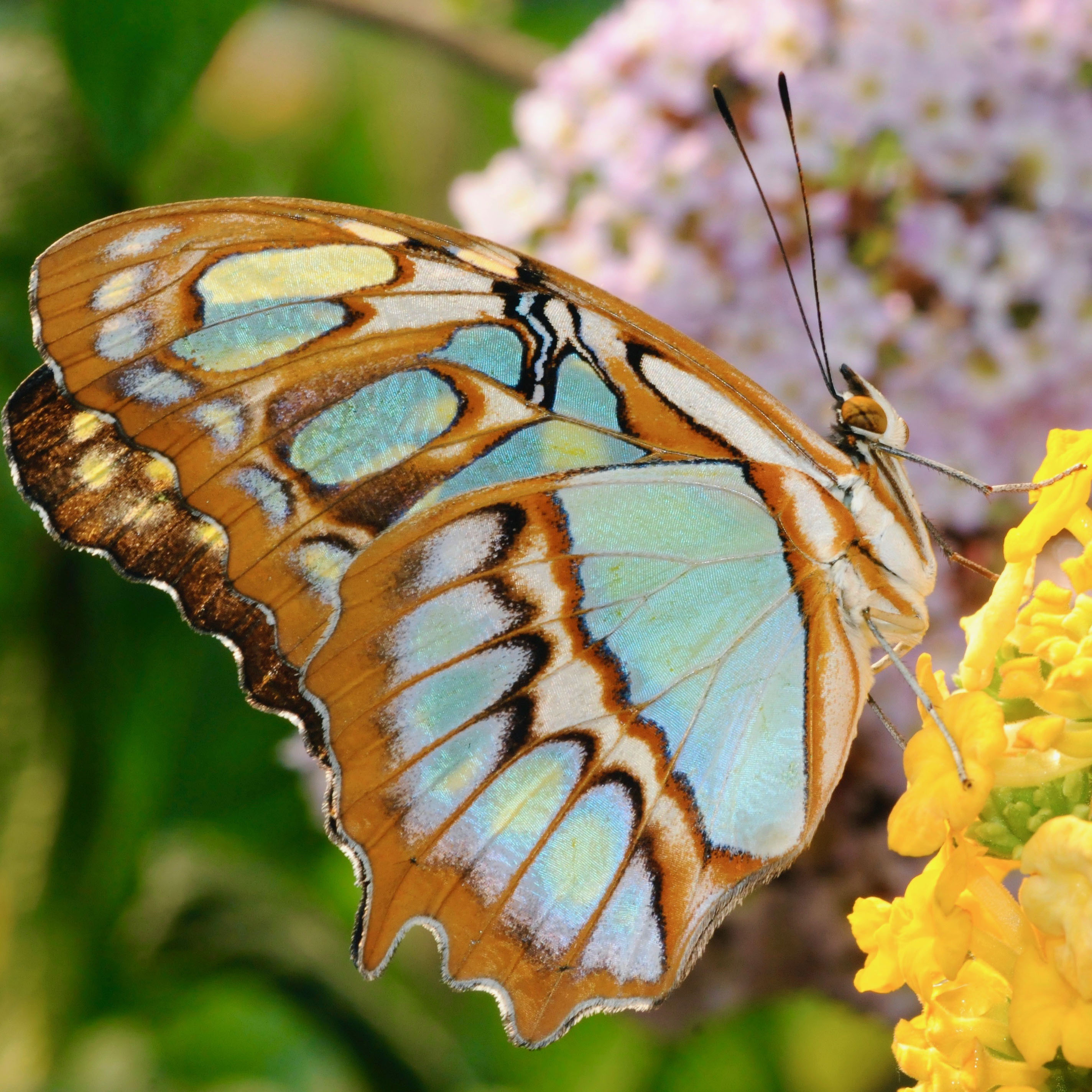
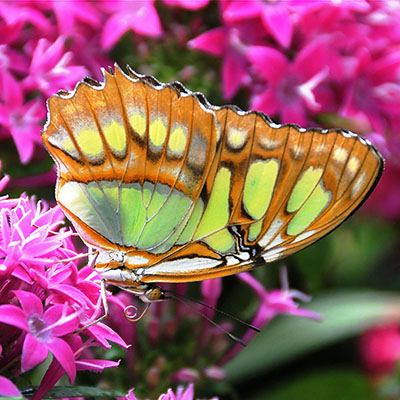
Leprechauns love butterflies because they flaunt every color of the rainbow. Some real butterflies are even green, such as the Malachite, Olivewing and Paris Peacock pictured below, but I seriously doubt whether they could be Irish too!

Never trust a Leprechaun, but do visit our Kid’s Craft Page, where you can download butterfly coloring pages for free! May the road rise to meet you and the butterflies always be at your side… Happy St. Patrick’s Day from OWB!

What Do Butterflies Eat?

We often get asked, “What do butterflies eat?”. . .

Butterflies eat (drink or sip) nectar through a straw-like mouth part called a proboscis  (pro-boss-kiss). Nectar is a sugar rich liquid produced by flowering plants like cosmos, verbena, zinnias, butterfly bush and yarrow.  There are thousands of flowers that butterflies can obtain nectar from.

Along with nectar, the male butterfly also needs a variety of minerals, which they acquire by sipping on ripe or rotting fruit, tree sap, piles of manure or mud.  This typical butterfly behavior is called puddling.

If you have butterflies in a cage or enclosure for more than a day, they will need to be fed.  They can be fed a variety of ripe juicy fruits, like watermelon, melons, oranges, cherries, strawberries, peaches and plums. Caged butterflies will also enjoy sipping on Gatorade and homemade nectar.   You can make your own butterfly nectar by mixing 4 parts water to 1 part granulated sugar.  Boil the mixture for a few minutes then be sure to allow the sugar mixture to cool before feeding butterflies.  Use cotton balls soaked with either the homemade nectar or Gatorade and placed on a small plate.  If the enclosure is large enough, you can also place a few potted flowering butterfly nectar plants inside to keep the butterflies happy and well fed.

To help keep male butterflies happy and enticing to female butterflies in your garden or enclosure, be sure to include a “puddling” area.  This can be done by place smooth round stones in a shallow dish along with some mud or wet soil.

If you know of a certain flower, fruit or other sweet treat that butterflies seem to love, please share your knowledge with our readers and leave us a comment below.

Enjoy the butterflies,

Vickie