Monthly Archives: June 2010

NABA 4th of July Butterfly Counts

Celebrating its 36th year in 2010, the North American Butterfly Association (NABA) Butterfly Count Program is a long-term citizen-scientist project, involving almost 500 counts and thousands of volunteers throughout the United States, Canada, and Mexico. Volunteers select a count area with a 15-mile diameter count circle and assemble a group to conduct a one-day census, of all butterflies sighted within that circle.

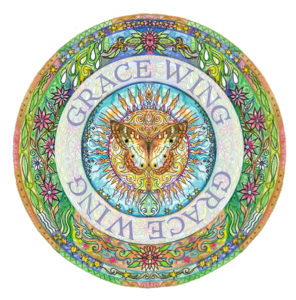
Butterfly Counts are usually held around the fourth of July. To learn more about them click the star spangled butterfly above. For free down-loadable 4th of July Butterfly coloring pages click on the Star-Spangled Butterfly coloring page below.

<

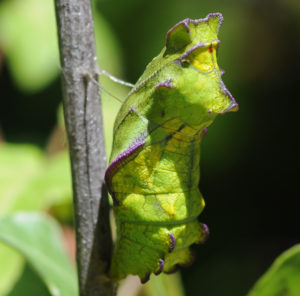
Mystery Chrysalis CONTEST…Can you guess what am I am?


If a predator were to look closely at you, they might see the outlines of your wings, antennae or abdomen. They might even see
that you are an immobile butterfly in the making.
Defenses are few for a strung up statue…

-K. D’Angelo (from Butterfly Dimension)

Be the first to correctly identify which species of butterfly this chrysalis will become and WIN a set of 4 assorted Butterfly Note Cards!
(Spots of Color shown above).  Each signed by Award Winning Artist, Lorac
. Visit our Butterfly Shop to view other card styles available.

To enter the contest, leave us a comment with your “best guess”.  You will find the “comments” link at the top of this blog post and good luck!

Contest Ended  Midnight, June 30, 2010

The answer to the Mystery Chrysalis is shown below…


I am a Pipevine Swallowtail (Battus philenor) Buttterfly…. One of Mother Nature’s many wonderful mysteries set aflutter.

What’s in a Name? The Euphydryas chalcedona Butterfly…

The Euphydryas chalcedona butterfly is also known as the Chalcedon Checkerspot, the Variable Checkerspot, the Anicia Checkerspot and the Colon Checkerspot… which butterfly is this anyway ???

Euphydrayas chalcedona

Most people use common names when referring to local butterflies, but each butterfly also has a scientific name assigned to it and thank goodness for that!

Silene california (Silene meaning - perennial with red or pink flowers).. aka California Indian Pink or California Scarlet Campion

Throughout the history of western science most documentary literature, with respect to the naming of a species, has been written in Latin. The practice of using Latin descriptions has continued over time so that scientists and others who speak different languages can communicate and understand that they are talking about the same species. Many plants and animals have common names which differ by regions and using universal names to identify a group avoids confusion among all.

The Latin title given to a particular species may be assigned for many different reasons. Some are named after characters found in Greek or Roman mythology, others are titled because of where they were found or who discovered them, and many receive their labels due to unique appearances or patterns of color.

Euphydrayas chalcedona... variable with a beautiful deep orange-red color

In the case of  the Euphydrayas chalcedona, we can learn by researching the origins of the word that the butterfly was named for it physical characteristics.

The name Chalcedon came from the Latin word, chalcdonius,which is derived out of the Greek term, khalkdn, meaning a mystical stone (Revelation 21:19). Both expressions are thought to have originated from the Phoenician word hadiic kapr, meaning “new town”.

Chalcedony is a quartz stone which has a waxy luster and may be translucent or semi-transparent. It is though to get its name from the ancient Greek town of Chalecdon. This

Red Chalcedony Quartz

mineral can assume a wide range of colors, including white, pale-blue, gray, brown or black. It can also be found in a lovely variegated deep orange-red color, hence, the naming of  the Euphydrayas chalcedona butterfly.

To learn more about the Latin names of butterflies… click the scholarly image below…

Come to a Caterpillar Convention… Caterpillar Phacelia (Phacelia circutaria)

The name Phacelia comes from the Greek word, phakelos, which means bundle.

Caterpillar Phacelia, Phacelia circutaria, is a plant species native to California, which looks exactly as it’s name suggests, like a bundle of caterpillars.

Look for this group of hairy, sun-loving annuals from March to June in the chaparral covered foothills of California.

Coming upon them is like attending a Caterpillar Convention, where each participant seems to enjoy flaunting it’s flora, exhibiting tiny buds as if they were fancy hats atop it’s head.

If you hung around long enough (for several weeks at least), you could watch as each coiled stem slowly unraveled itself, proudly showing off it’s pretty lavender flowers, one by one…

Click the cute but sassy fellow above (just returned from the convention I guess) to learn more about Caterpillar Phacelia (Phacelia cicutaria), one of the few “caterpillar” species in nature which does not become a butterfly! KD


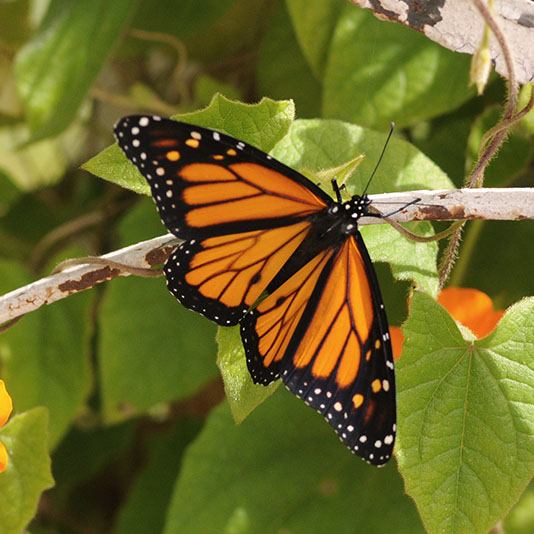
Monarch Butterfly Postage Stamp

Monarch Stamp

Monarch Butterfly Postage Stamp

On May 17, 2010, the United States Postal Service issued a 64–cent, Monarch (Butterfly) definitive stamp, designed by Derry Noyes of Washington, DC.

The Monarch stamp was designed for use on large-size non-machinable greeting cards. Many cards that require the additional postage will carry an outline of a generic butterfly on their envelope to suggest to customers that they may want to purchase the new Monarch stamp!

Lepidoptera

Nationally acclaimed artist, Tom Engeman of Bethany Beach, Delaware, used images of preserved butterflies to inspire the stamp art he then created by computer. The result is a highly stylized, simplified image of the monarch rather than an exact replica.
Tom Engeman is well known for his poster and stamp designs. It was the strong shapes and bold colors of a small butterfly poster that caught the eye of art director Derry Noyes and led to the creation of the new Monarch stamp.

The artist began construction of the Monarch by drawing only half of the butterfly with a black felt-tip pen on graph paper. This drawing was scanned into Engeman’s computer, and color was added digitally.

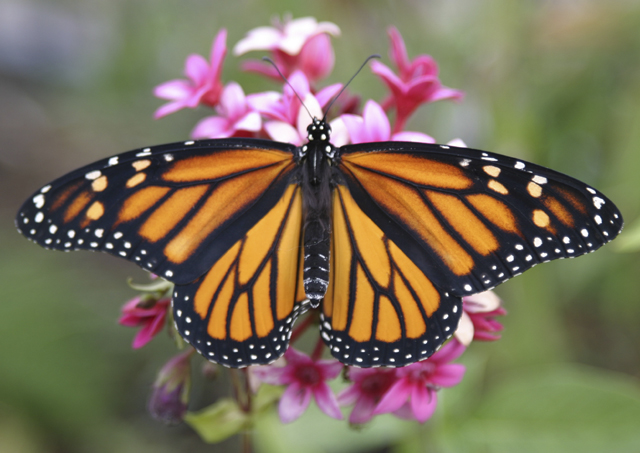
Monarch Butterfly

Working in Adobe Illustrator software, Engeman created rough shapes that corresponded to the open spaces inside the Monarch wing and body. These shapes were built on a layer above the black-and-white drawing and were filled with flat or gradient color. Once the shapes were created and colorized, Engeman moved the black-and-white drawing back on top to yield a finished butterfly half. This half was copied and flopped to create a mirror image, and the two pieces were merged to form a complete butterfly.

Expect to see more of Tom’s beautiful butterfly images on other stamps!

Issue Type: Definitive
Issue City: New York City, NY 10199
Issue Date: May 17, 2010
Issue Series: Butterfly