Monthly Archives: March 2010

Fly Away Palos Verdes Blue!

Photo: Gary Friedman / Los Angeles Times


The rare Palos Verdes Blue butterfly (Glaucopsyche lygdamus palosverdesensis) took flight on a wind-swept bluff of the Palos Verdes peninsula in Southern California on Saturday, March 7th 2010.  Then another. Then another! Conservationists released 80 endangered butterflies in all, each bred in captivity, venture into the wild.

It was a big step into saving the Palos Verdes Blue butterfly from extinction.  This butterfly’s life is short, living for five to 10 days, it must work quickly to reproduce. During it’s short life, it must find nectar for energy, chose a mate, locate it’s host plant, locoweed (Astragalus trichopodes var. lonchus) and finally lay eggs for the survival of it’s species.

There are now as many as 10,000 Palos Verdes Blues compared to 1994 when they were at the brink of extinction.  Still, they face years of conservationist’s help before they can be removed from the federal list of endangered species.

A big thanks to conservationist at the The Urban Wildlands Group.  The UWG is dedicated to the conservation of species, habitats, and ecological processes in urban and urbanizing areas.

Ten Facts About Monarch Butterflies Everyone Should Know

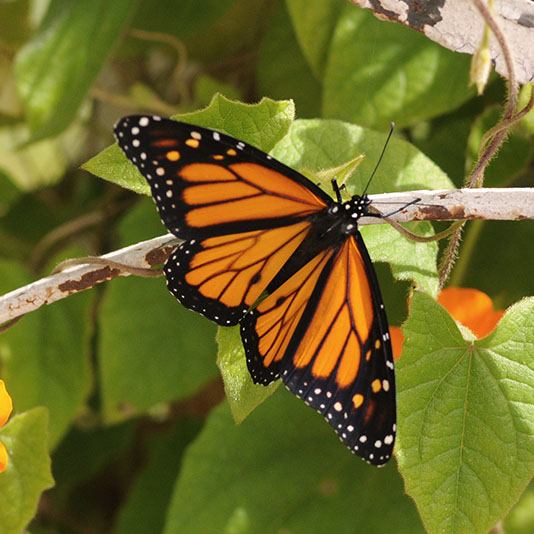
Female Monarch Butterfly on Pentas

MONARCH BUTTERFLY: TOP TEN FACTS

#1 MIGRATION

Hundreds of millions of monarch butterflies migrate from eastern North America to Mexico each fall to overwinter in the high elevation oyamel fir forests of the Transvolcanic Range of central Mexico. Monarchs are unable to survive freezing temperatures and those breeding in temperate regions must escape to moderate climates to reproduce the next season.

#2 GENERATIONS

Most of the monarchs joining the migration each fall are 3-4 generations removed from those that made the journey the previous year.

#3 TIME AND DISTANCE

The migration begins in mid August in the north and in September at mid latitudes. The migration progresses at a pace of 25-30 miles per day, although individual butterflies often fly further during periods when conditions are favorable. Most monarchs originate from locations more than 1500 linear miles from the overwintering sites. The duration of the migration appears to be 2-2.5 months.

#4 RECOLONIZATION OF THE SUMMER BREEDING AREAS

The monarch breeding areas in eastern North America are recolonized by two generations of monarchs; the overwintering butterflies that move north in the spring and their offspring. The latter reach maturity and begin flying N/NE in late April, reaching the northern limits of milkweeds by mid-June.

#5 LONGEVITY

Migratory monarchs that survive the winter in Mexico are 8-9 months of age and may be the longest lived of all butterflies. In contrast, reproductive monarchs breeding during the summer months only live 2-5 weeks due to the high cost of reproduction.

#6 NUMBERS

Monarch populations are measured as the number of hectares (1 hectare = 2.47 acres) of trees occupied by clustering butterflies in mid-December of each year. The size of the population has varied from 2.19 to 18.2 hectares over the last two decades; averaging close to 9 hectares in the 90s and between 5-6 hectares in this decade.

#7 NAVIGATION

Migrating monarchs in the interior of the continent fly in directions that seem to be geographically appropriate given the need to reach Mexico. How the butterfly determines these directions is the unanswered navigation question. Components of the navigational system that are known involve a time-compensated sun compass linked to the circadian clock, and a protein (Cry1) that is sensitive to blue light and ultraviolet wavelengths.

#8 TAGGING

Tagging by Monarch Watch volunteers has helped define the migration window as well as the timing and pace of the migration. Tagging also shows that the probability of reaching Mexico is related to geographic location, size of the butterfly, and the date (particularly as this relates to the migration window for a given location).

#9 DIMINISHING RESOURCES: THREATS TO THE MONARCH MIGRATION

During the breeding season monarchs require milkweed plants upon which to rear their larvae and nectar sources to sustain the adults during reproduction. Nectar sources are also required by the butterflies to fuel the fall migration to Mexico as well as the spring flights northward. Overwintering monarchs require shelter and water. All of these resources are diminishing. Deforestation at the overwintering sites in Mexico has eliminated a number of former colony sites and others have been badly degraded so as to reduce the shelter and water available to wintering butterflies. In the United States, 6000 acres are converted to development each day, eliminating milkweeds needed by monarch larvae and nectar sources required by adult monarchs. Chemically intensive agriculture and roadside management by excessive mowing and use of herbicides have also eliminated monarchs and their milkweed hosts. Lower numbers of overwintering monarchs in this decade may be related, at least in part, to habitat loss.

#10 CONSERVATION

Sustaining the monarch migration will require the cooperation of all three countries (U.S.A., Canada, Mexico) that are home to monarchs for some portion of the year. Future efforts will be based on the “North American Monarch Conservation Plan” – a program that advocates the implementation of measures to enhance, restore, and protect monarch habitats.

Thanks to Dr. Orley R. “Chip” Taylor, Director of Monarch Watch www.monarchwatch.org

The Flying Irish… Butterflies?


Leprechauns love butterflies because they flaunt every color of the rainbow. Some real butterflies are even green, such as the Malachite, Olivewing and Paris Peacock pictured below, but I seriously doubt whether they could be Irish too!

Never trust a Leprechaun, but do visit our Kid’s Craft Page, where you can download butterfly coloring pages for free! May the road rise to meet you and the butterflies always be at your side… Happy St. Patrick’s Day from OWB!