Monthly Archives: August 2009

Milkweed – Ensuring the Survival of Monarchs

Swamp Milkweed (Asclepias incarnata)

Swamp Milkweed (Asclepias incarnata)

Milkweed (Asclepias) is a natural wonder
- the host plant for the monarch and the queen butterflies.
Without milkweed, these butterflies would cease to exist.

Milkweed is also an important nectar source for butterflies, bees and other nectar seeking insects.

Narrowleaf Milkweed (Asclepias fascicularis)

Narrowleaf Milkweed (Asclepias fascicularis)

Milkweed gets its common name from the milky sap it secretes when you snap a leaf or break the stem. The milky substance contains cardenolides which are consumed by the feeding caterpillars and stored in the body of the adult butterfly making them toxic and bitter-tasting to potential predators.

California Milkweed (Asclepias californica)

California Milkweed (Asclepias californica)

This beautiful and important perennial belongs to the genus Asclepias.  There are over 150 species of Milkweed in the world with most of them being native to North America, South America, and southern regions of Africa.

Pictured is just a sampling of the colorful and diverse varieties of milkweed.

Silky Gold Tropical Milkweed (Asclepias curassavica)

Silky Gold Tropical Milkweed (Asclepias curassavica)

To ensure the survival of  Monarch Butterflies, be sure to plant plenty milkweed in your garden!

Milkweed photographes taken by Bobby Gendron, owner of Butterfly Encounters.

Butterfly Encounters offers over 20 species of milkweed seeds and provides detailed information about growing milkweed from seed.

Butterfly Inspired Colored Pencils

colored pencils butterflyJust in time for BACK TO SCHOOL!

Set of 24 artistic colored pencils in a beautiful collectible tin illustrated by Lizzy Rockwell.

Each color has been inspired by butterflies, with names like Chrysalis Green, Painted Lady Pink, Marine Blue and Purplewing.

Fly by ObsessionWithButterflies.com to purchase your set today!

Colored Pencils

Do You Twitter?

Obsession With ButterfliesObsession With Butterflies is Twittering!

Follow us on Twitter for inspiring butterfly news, links, images and information!

Go to twitter.com search for OWButterflies and become a follower!

“Never say Never”?…Photographically Capturing the Face of California’s State Butterfly

Male California Dogface

Male California Dogface

I have been dogged again, trying to clearly photograph the hounds hidden upon the inner wings of California’s State Butterfly. Typically, I consider myself an optimistic person, often voicing such mantras as “never say never” and “anything’s possible if you try”, however, in the case of the California Dogface (Colias eurydice), I am beginning to wonder if these pollyannaish words of wisdom can hold true?

Female California Dogface on Gravel Ghost

Female California Dogface on Gravel Ghost

Dainty pink hues color the edge of the female California Dogface. Unlike her male counter-part, she is otherwise predominately soft yellow in tone, a sweet and feminine beauty who is not at all concerned with her namesake.

Two Male California Dogfaces

Two Male California Dogfaces

Flashes of orange-yellow & black flicker by as male California Dogfaces flutter about. Use caution, when trying to glimpse the canine imagery which Mother Nature has dabbed upon their wings, for, I myself, have been burnt many times trying to photograph these elusive dancing flames.

Male California Dogface on Coyote Mint

Male California Dogface on Coyote Mint

Butterflies within the Sulphur family, such as Dogfaces, are known to perch only briefly and always with their wings closed. This, along with the fact that their flight is most often quick and erratic, creates quite a challenge for anyone who wishes to naturally photograph the interior surfaces of these lovely and intriguing creatures.

Female California Dogface

Female California Dogface

Naturalist, conservationist and former President, Theodore Roosevelt said “if at first you don’t succeed, try, try again”. Despite my many failed attempts, think I will follow his advice and keep on trying to artlessly capture a nice sharp image of the blue-eyed pooches who hide-out upon the male Dogface’s wings. “Never say Never”… right!  I’ll keep you posted. – K. D’Angelo

Male California Dogface on Bladderpod

Male California Dogface on Bladderpod

For more information on the California Dogface go to:

Obsession With Butterflies information for the California Dogface

Life of a Pale Swallowtail Caterpillar

Newley Emerged Pale Swallowtail Caterpillar

Newley Emerged Pale Swallowtail Caterpillar

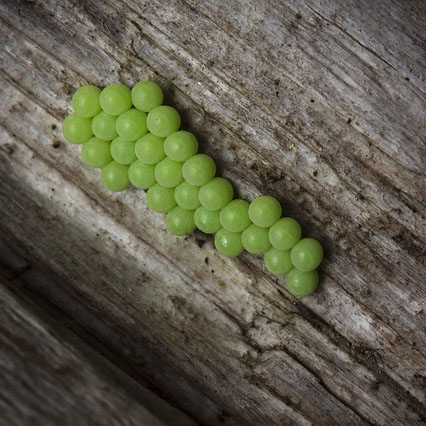
This post is a follow-up to two earlier posts I wrote titled “Pale Swallowtail Butterfly Eggs” and “Butterfly Egg Hatches“.

The life of a pale swallowtail caterpillar is not only rare to experience, but extremely slow and methodical compared to other caterpillars I’ve raised.

The tiny pale swallowtail caterpillar hatches from it’s egg in only 4 days, spending most of it’s first day eating it’s own egg shell before setting out to explore it’s new surroundings.

If you’ve read my previous posts, you know the egg was mistakenly laid on a common fruit bearing peach tree in my neighbors back yard (peach trees are not considered to be a host plant for the pale swallowtails, although peach trees are in the prunus family).

Pale Swallowtail Caterpillar 2nd instar

Pale Swallowtail Caterpillar 2nd instar

I had offered the newly hatched pale swallowtail caterpillar a smorgasbord of host plants to eat.  Finally settling on the coffeberry (Rhamnus californica), taking only a small bite on the edge of the leaf, then returning to the center of the leaf to rest for the remainder of the day.

After watching the pale swallowtail for a couple of weeks now, I’ve started to realize there is a mythological pattern in it’s behavior.  First of all, this is a very long time for a caterpillar to still be a caterpillar and the time it takes to molt (intsar) is much slower than other caterpillars I’ve raised. I have rarely seen my pale caterpillar move, let alone eat.  I check on it first thing in the morning, noticing that the coffeeberry has been munched upon and frass (caterpillar droppings) are in the bottom of the container, but the caterpillar is in the exact same position as the day before.  I’ve realized the actions of my pale swallowtail caterpillar are all done privately, in the middle of the night.

Pale Swallowtail Caterpillar 5th Instar

Pale Swallowtail Caterpillar 5th Instar

The larger and more mobile a caterpillar becomes, the more visible and tempting it is to potential predators. Newly interested parties including birds, lizards and spiders are among the large list of dangers a caterpillar can face. Such luxuries as claws, beaks and venom are not at a caterpillar’s disposal. Nor can a caterpillar scamper, hop or fly away quickly from a perilous situation. Fortunately, however, over time these amazing creatures have adopted and learned to survive despite the incredible challenges they face each day.” Excerpt from Butterfly Dimension by Kristen D’Angelo.

Day after day, moving slowly, molting, pooping and eating only at night, he grows. My methodical pale swallowtail caterpillar is in it’s 5th instar, almost ready to pupate into a chrysalis.  I’ll keep you posted.  ~ Vickie

Hope for the Flowers

“How does one become a butterfly?” she asked. ”You must want to fly so much that you are willing to give up being a caterpillar.” - Trina Paulus

Looking much like an inmate in his striped coat, this Monarch caterpillar mindlessly munches away on some milkweed... but..

Looking much like an inmate in his striped coat, this Monarch caterpillar mindlessly munches away on some milkweed... but..

Hope for the Flowers by Trina Paulus

Hope for the Flowers by Trina Paulus

"One cannot consent to creep when one feels the impulse to soar." - Helen Keller

"One cannot consent to creep when one feels the impulse to soar." - Helen Keller

Quote by Trina Paulus is an excerpt from her timeless children’s book “Hope for the Flowers
“. Great wisdom from such an unassuming source. Buying myself a copy today! -K. D’Angelo

For more information on Hope for the Flowers
click the following link…