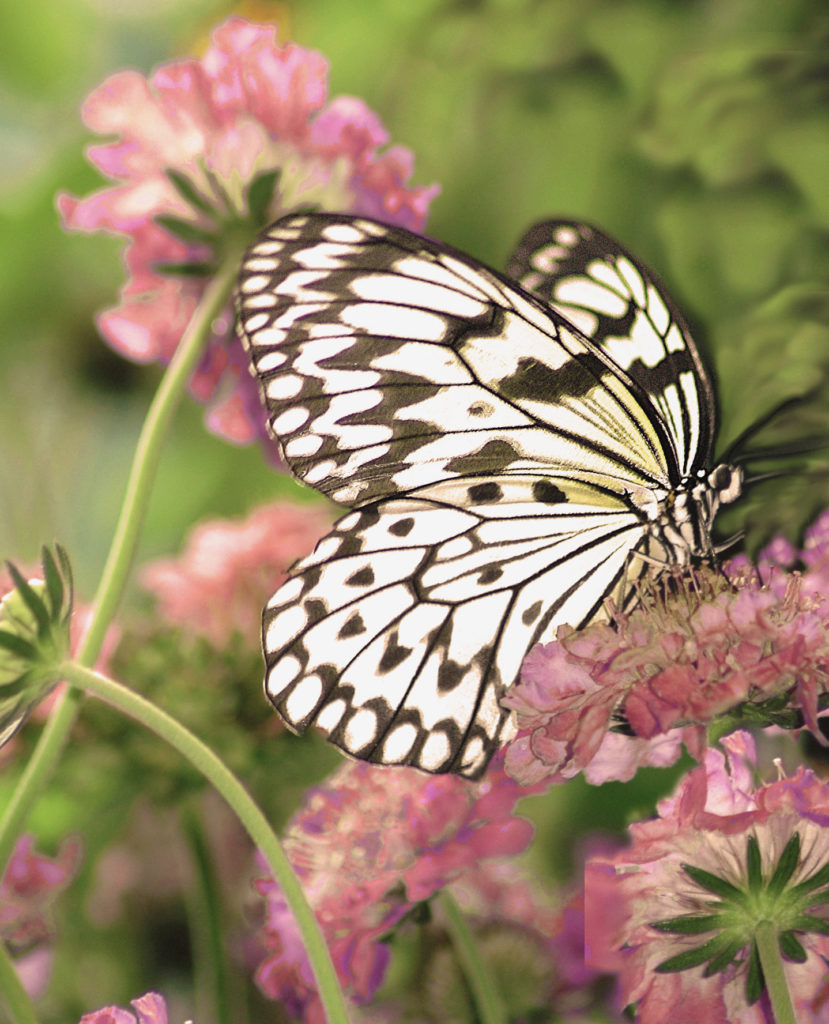
This lovely poem was written and kindly shared with us by Mr. Phil Ellsworth. It was composed for Margaret Ellsworth, his beloved wife of 55 years, whom he recently lost. The beautiful prose is a telling of their chance or maybe not so chance (was it the Butterfly Effect?) meeting many years ago. The poem and their story is further reflected upon by Mr. Ellsworth in the account written below.

What Butterfly
Disturbed the Air
Changed the World
and
Swept me Where
I Chanced to see You
Passing By?
Dear Butterfly,
Dear Butterfly…
© Phil Ellsworth
“I’ll tell you about the poem. I am a geologist so have had an interest in physics and have been interested in chaos and the butterfly effect. I met Margaret in Grand Junction in 1951 and then didn’t see her for over a year. Then by accident we met again while I was getting gas in Craig, Colorado, her home town, as I was traveling between Gillette, Wyoming, and Grand Junction. She was a nurse at the Craig hospital and had come off shift and gone to town on an errand. I believe that the state of the world at the instant of our meeting was due (in part, of course) to the flapping of some butterfly’s wings somewhere. How can I not have an affection for butterflies?” Phil Ellsworth
A most sincere thank you to Mr. Ellsworth for sharing this thought provoking and touching story with us. To read more about The Butterfly Effect click the following link…http://www.answers.com/topic/butterfly-effect-2

I do not know whether I was then a man dreaming I was a butterfly, or whether I am now a butterfly dreaming I am a man. -Chuang Tzu
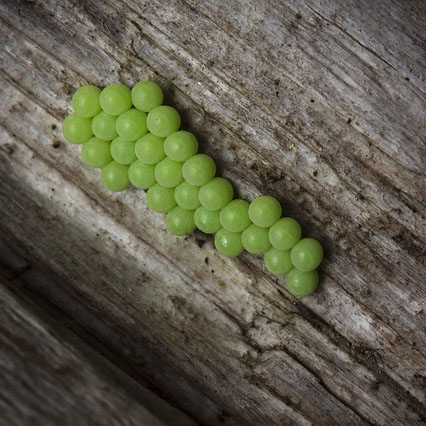
Pale Swallowtail Butterfly Egg
One of the 3 Pale Swallowtail eggs has darkened up and looks like it’s getting ready to hatch. The other two eggs are still clear, I suspect they are duds, but I will know for sure in a couple days.
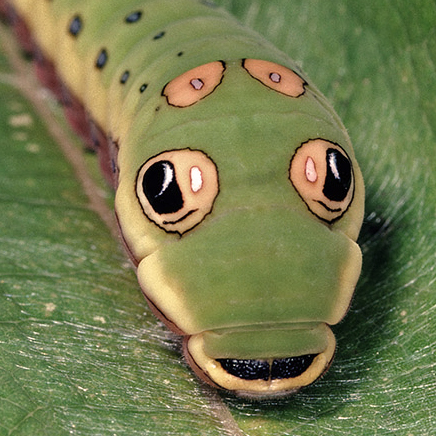
The darkened egg hatches and out crawls. . .a tiny pale swallowtail caterpillar. First thing he does is eat his entire egg. I’ve set him up at a “makeshift salad bar” complete with the most tender green leaves of coffeberry, cherry, California lilac and, and of course the leaf that he was laid on, peach (which is NOT considered a host plant for the pale swallowtail) . 
Coyote Mint (Monardella villosa)

Coyote Mint
Have you seen a butterfly nectaring on a particular flower? In my garden, the butterflies prefer to visit the Coyote Mint.
Coyote Mint grows to about 2 feet high with soft gray-green leaves and pinkish purple flowers in late spring and summer. Coyote Mint is native to the California and is drought tolerant. It has a minty toothpaste aroma and was used by the Spanish as cure for sore throats. Make sure to plant some for the butterflies that visit your garden.
Which flowers are butterfly favorites in your garden? Which butterflies do they attract?


Pale Swallowtail Eggs
My friend Eva watched a Pale Swallowtail (Pterourus eurymedon) lay eggs on her Peach Tree (Prunus) today, then she gave me the eggs! I’m not sure all 3 eggs will hatch, but I will keep you posted on their progress and let you know what the caterpillars decides to eat.
The “preferred” host plants for the Pale Swallowtails are plants in the buckthorn fmaily, including Mountain Lilac, Mountain Balm, California Lilac (Ceanothus), Holly-Leaf Cherry (Prunus ilicifolia) and Coffeeberry (Rhamnus californicus) and Alders (Alnus). This will be only the 3rd time I’ve had the pleasure of raising Pale Swallowtails and would love to hear from someone who has sucsessfully raised Pale Swallowtail Butterflies.

Got the Blues? If you can’t beat them join em!
(Square-spotted & Dotted Buckwheat Blues)
Whether your feeling a bit low or not, chilling with some Blues is bound to better your mood. I found this straggle of buckwheat lovers partying it up on the trail to Holy Jim Falls in the Santa Ana Mountains, CA. The females were laying eggs, the males were puddling… all were having a grand time just hanging with the soft, lush buckwheat ( Eriogonum fasciculatum foliolosum). Don’t get me wrong, being with these guys was very cool and I loved every moment of it, but keeping company with the Buckwheat Blues can also be very confusing. Even after sharing an intimate afternoon with these butterflies, I still could not clearly tell who was a dot and who was a square.
Fred Heath, a fellow groupie and author of An Introduction to Southern California Butterflies, had this to say about his experiences with these particular butterflies. “Distinguishing the Square-spotted Blue (Euphilotes battoides) from the Dotted Blue (Euphilotes enoptes) is quite difficult…”. Mr. Heath goes on to say that “Generally, the Square-spotted has heavier black markings below, including the lines along the margins, and the orange in its hindwings is continuous as opposed to being separated into spots.”
Hmmmmm, thanks so very much to Mr. Heath, could be my mellow state of being, but I am still feeling a bit bemused as to which species is which here. DNA barcoding where are you when I need you! (read more on this here http://www.lepbarcoding.org/index.php ) Based on what I can see I am guessing that both of the aforementioned species were represented on the trail to Holy Jim Falls, although, I am not certain and welcome any feedback or commentary. Just don’t bring me down ok… or else I’ll have to be off chasing those blues again… -K.D’Angelo


Cabbage Whites
Cabbage White Family

Just one day old...aren't we cute!
The Cabbage White (Pieris rapae) is one of the most common travelers to frequent our skies. Due to its abundance this delicate white butterfly is often overlooked and sometimes even thought of as a pest. Carrying a non-native stamp upon wing, it was introduced into the North American continent from Europe in the early 19th century.
Cabbage, hence its name, nasturtium and cultivated mustards are among this species favorite hosts and because these, and other host plants, are widely available this opportunistic flier has thrived. Although the Cabbage White is often met with disdain, I am kind to this cheery and ambitious butterfly when it visits my garden. -K.D’Angelo

It's my birthday..a whole week old..so soft & fuzzy too!

Teenagers! Come on everyone goes through a gawky stage...

Look at me now... I can FLY!
When the sweet Sara Orangetip (Anthocharis sara) flutters by, you know that springtime has arrived in Southern California’s coastal communities.
I spent an afternoon watching for this citrus tipped beauty as I explored the chaparral which adorns the rolling hills above the city of San Clemente.

To my delight I found a couple of courting Orangetips. The female was more interested in the nectar laden Sea-Lavender (Limonium) than she was in flirting with the male and so he was rejected repeatedly. Poor fella!

Upon further study, I also noticed that this particular lady appeared to have the markings of the Desert Orangetip (Anthocharis centhura) and the male looked as though he were a Sara Orangetip (Anthocharis sara).

Had she drifted over with the currents from Santa Catalina, I wondered, as I stood upon the cliffs gazing at the petite isle silhouetted amongst the pacific skyline.

Had she left the solitude of her isolated colony there to search for her favorite host plant, some native mustard, Tansy perhaps? (Descurainia pinnata) If this is the case, and you’re a male Sara Orangetip looking for a mate, then it’s best to stay clear of out- of -towner’s I guess. -K.D’Angelo